
If you don’t fix governance first, you can’t fix delivery. If you don’t fix data, you can’t fix governance. If you don’t fix decisions, you can’t fix strategy..
Your situation is more common than most organisations realise:
- Late deliveries
- Unstable deployments
- Production incidents
- Low confidence from the business
Yet every dashboard is green. Status reports say “on track.” Engineering leadership gives a thumbs-up.
That contradiction is not accidental. It is structural.
Fractional Tech’s rescue engagements consistently confirm the same insight:
If you don’t fix governance first, you can’t fix delivery. If you don’t fix data, you can’t fix governance. If you don’t fix decisions, you can’t fix strategy.
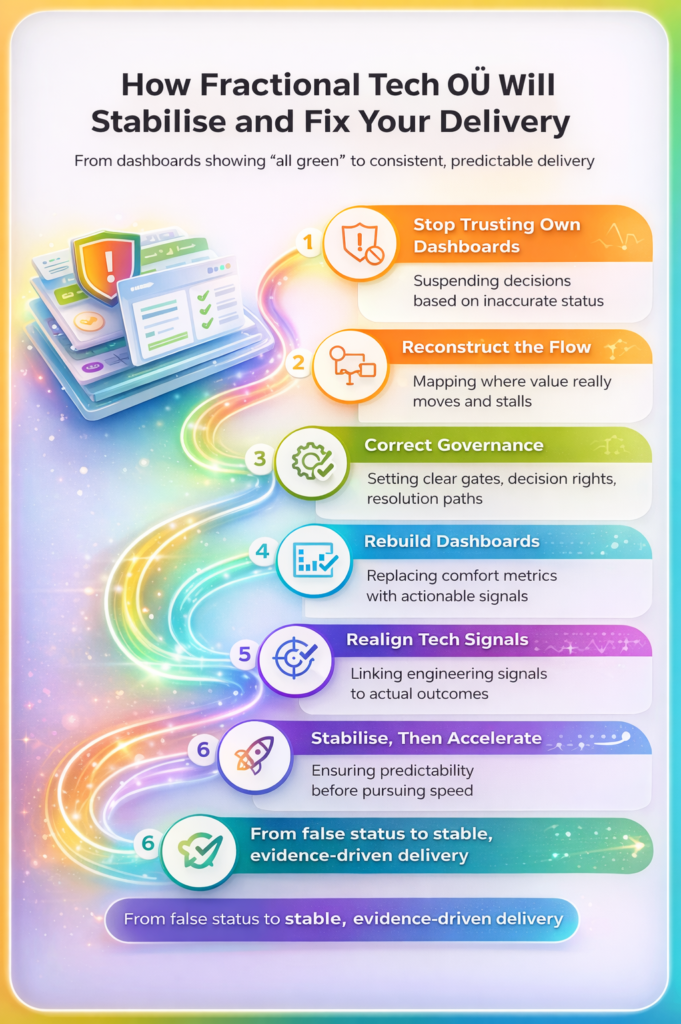
What follows is how we intervene—practically, step by step.
Step 1: We Stop Trusting the Dashboards (Temporarily)
Dashboards do not fail on their own. They fail because they measure activity instead of flow, and progress instead of outcomes.
In your case, the dashboards are likely showing:
- Story completion
- Sprint burn-down
- Deployment counts
- “All environments green”
None of these explain:
- Why value arrives late
- Why deployments fail
- Why production is unstable
- Why teams feel confident while outcomes fail
Our first move is to suspend decision-making based on existing dashboards. Not remove them—just stop treating them as truth.
Step 2: We Reconstruct Reality Using Flow
Before fixing tools or people, we rebuild an end-to-end delivery flow view:
From:
Idea → Commitment → Build → Deploy → Operate → Real value
We map:
- Where work actually waits
- Where handoffs occur
- Where quality is injected vs inspected
- Where decisions stall delivery
- Where risk is discovered after release instead of before
This immediately exposes why “green” reports coexist with real failure.
Flow never lies. Reports often do.
Step 3: We Correct Governance—Not by Adding More Meetings
Your problem is not lack of governance. It is misplaced governance.
We fix this by re-establishing:
- Clear decision ownership (who can say “yes”, “no”, or “stop”)
- Explicit quality gates (what must be true before deployment)
- Outcome-based controls instead of progress-based reassurance
- Escalation paths that actually trigger action
This often reveals a hard truth:
The system rewards optimism, not accuracy.
That is why everything looks green.
Step 4: We Rebuild Dashboards to Reflect Flow, Not Comfort
Only now do we touch dashboards.
We replace “comfort metrics” with decision-grade signals, such as:
- Time-to-value (not time-to-complete)
- Deployment success rate vs deployment frequency
- Production incident recovery time
- Value leakage (planned vs realised outcome)
- Failure demand (rework created by the system itself)
These metrics:
- Expose delivery risk early
- Remove false confidence
- Force better decisions upstream
Importantly, they are designed for leaders, not just delivery teams.
Step 5: We Realign Engineering Leadership Signals
When lead developers and architects give a thumbs-up during poor outcomes, it usually means:
- They are measuring technical success, not business success
- They are insulated from downstream impact
- The governance model does not connect architecture decisions to operational outcomes
We correct this by:
- Making architectural decisions visible in flow metrics
- Linking deploy quality to operational impact
- Aligning technical “done” with business “working”
This is not about blame. It is about accountability clarity.
Step 6: We Stabilise First, Then Accelerate
Only once governance, flow visibility and decision clarity are restored do we focus on speed.
This prevents the most common failure pattern:
Accelerating a broken system.
The result is:
- Fewer surprises
- Fewer emergency fixes
- Predictable delivery
- Honest reporting
- Leadership confidence grounded in evidence, not optimism
What This Means for You
You do not have a tooling problem. You do not have a dashboard problem. You do not have a capability problem.
You have a truth problem.
Fractional Tech OÜ steps in to:
- Re-establish delivery truth
- Fix governance at the source
- Restore flow
- Align decisions to outcomes
- Turn dashboards back into instruments, not theatre
This is how stalled, unstable programmes recover—and stay recovered.
Leave a Reply